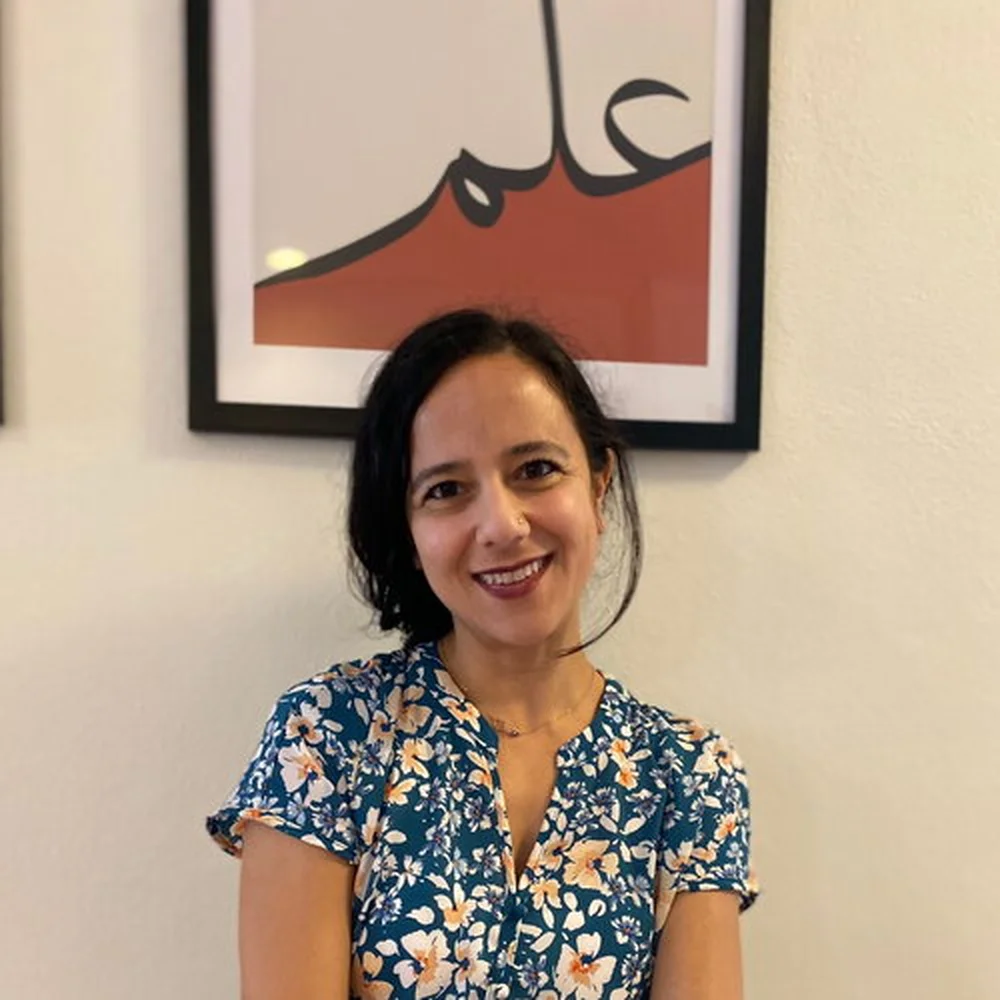
Professor Rana Khoury is a political scientist who studies conflict, displacement and humanitarianism, with Syria as her main case. We spoke about the year in Damascus that started it all, the project she calls "prolonged harm," what she expects after the fall of the regime, and how she keeps grief from crowding out analysis. The conversation has been condensed and edited.
ZM: It's a pleasure to talk to you! Can you introduce yourself, please?
RKH: My name is Rana. I am an almost fifth-year assistant professor of political science here at Illinois, and my research is on conflict, displacement and humanitarianism, specifically in the Middle East and more specifically still in Syria. I did my PhD at Northwestern and a postdoc at Princeton, and I grew up in Ohio, so I am a big Midwesterner! I like to think of myself as where the Midwest and the Mid East meet.
ZM: How did you end up working on Syria?
RKH: I am of Syrian heritage; my parents are both from Syria. After college I decided to spend a year there. This was before the conflict and I studied formal Arabic there, which felt like a foreign language! Most of my Arabic was relegated to kitchen talk, and I was more of a heritage listener than a heritage speaker. I was also volunteering with UNRWA, teaching English in Damascus and in an informal camp on the outskirts of the city. That is where my interest in forced displacement rose from.
By the time I got around to a PhD, Syria had gone from being one of the largest refugee host states to one of the largest refugee-producing states. I did most of my doctoral research in Jordan and Turkey. What interested me was that Syrians there were supporting not only other refugees but causes back home, in what was becoming rebel-held territory. My interlocutors kept pointing me toward international aid, which was not on my radar at the outset. Later I also built a data set of Facebook pages run by Syrian organizations, though I could not have audited it without the knowledge I had built up in person.
ZM: How did your research develop and what are you working on now?
RKH: A couple of years ago I resumed field research, sparked by an interest in protracted displacement. Syrian refugees were no longer in the news. Attention had been diverted to Ukraine and then Palestine, and with attention goes aid.
In February 2023 two massive earthquakes hit southern Turkey and northern Syria, an area with a very high concentration of Syrian refugees, so I became interested in what we might call double displacement. Maybe they have gotten good at surviving crisis. On the other hand, maybe it just knocked them down further. Later I interviewed Syrian refugees in Jordan after the fall of the regime, an event of a very different quality. What I did not expect to find is the similarity of Syrians’ responses to two such distinct moments. One is clearly destructive. The other has liberatory qualities. I am calling the project prolonged harm.
ZM: How do you deal with the psychological effects of this work?
Not relegating [people] to abnormal levels of violence, but saying there are people here, there are cultures here, there are literatures here, there are families here, there are people with agency here.
RKH: It is impossible! I have a couple of responses. One is that there is an extent to which we should accept that this is not normal, that we need to give ourselves grace, and maybe even occasionally make our supervisors aware of it. So: acceptance, and non-normalization.
The way I have told myself I am dealing with it is by turning on my analytical brain and trying to understand it, rather than only being paralyzed by the grief.
And I think we all have ways of standing in solidarity with humans in need wherever they are. Part of that, for us, is the work of humanizing the people and places we study. Not relegating them to abnormal levels of violence, but saying there are people here, there are cultures here, there are literatures here, there are families here, there are people with agency here. Let us better understand that, rather than allow this to be a region given a blanket label of violence and darkness.
ZM: What should we expect after the fall of the regime?
RKH: For every observer, analyst, Syrian, normal person, it was unexpected. Since 2016 the regime had been reconquering territory, and in the perverse way of a non-resolved conflict it appeared to be the victor. But it had corrupted its own institutions and been degraded from outside through sanctions, so it was actually quite brittle. The challenge now is translating a small governance project, over a homogeneous population in one corner of the country, to the whole of Syria, where every indicator of development is very low.
When all the odds are stacked against this turning into a thriving country, I think it is the people I studied for years who hold the greatest hope, because they are the ones who remained committed to bettering the lives of others during the war. The difference is that the international aid is not there any more.
ZM: In your teaching career at UIUC, which class do you most like teaching?
RKH: My contentious politics class, which is called Social Movements and Contention, a lecture of 90 students. They each choose a movement of their own and write short essays on it. They also produce memes; each lecture includes about five, made by students, about an argument in the readings. The driving questions are hard ones: why do social movements arise when they do, given that in all times and places people are aggrieved, and why do individuals participate at all, given the costs and the risks.
ZM: I close these interviews with a recommendation. What would you recommend to everyone reading this interview?
RKH: One of the coolest places on campus is the Salaam Center. I love that the director understands the importance of food, and of the culture of hospitality our region is known for, as a way to build bridges and create community. I have also been amazed by the student groups on campus, by these young people caring about people and places that are in some senses distant, and that in some cases they may never even have been to.