Title
South Asian Countries
Title
South Asian Countries
Image
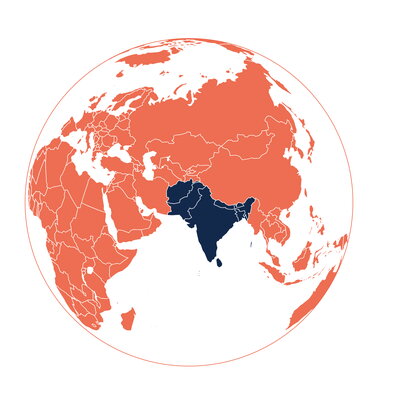
[Wikipedia summary, March 2025]
Afghanistan, officially the Islamic Emirate of Afghanistan, is a landlocked country located at the crossroads of Central Asia and South Asia. It is bordered by Pakistan to the east and south, Iran to the west, Turkmenistan to the northwest, Uzbekistan to the north, Tajikistan to the northeast, and China to the northeast and east. Occupying 652,864 square kilometers (252,072 sq mi) of land, the country is predominantly mountainous with plains in the north and the southwest, which are separated by the Hindu Kush mountain range. Kabul is the country's capital and largest city. Afghanistan's population is estimated to be between 36–50 million.
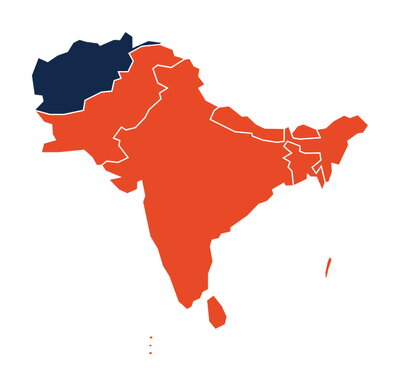
Human habitation in Afghanistan dates to the Middle Paleolithic era. Popularly referred to as the graveyard of empires, the land has witnessed numerous military campaigns, including those by the Persians, Alexander the Great, the Maurya Empire, Arab Muslims, the Mongols, the British, the Soviet Union, and a US-led coalition. Afghanistan also served as the source from which the Greco-Bactrians and the Mughals, among others, rose to form major empires. Because of the various conquests and periods in both the Iranian and Indian cultural spheres, the area was a center for Zoroastrianism, Buddhism, Hinduism, and later Islam. The modern state of Afghanistan began with the Durrani Afghan Empire in the 18th century, although Dost Mohammad Khan is sometimes considered to be the founder of the first modern Afghan state. Afghanistan became a buffer state in the Great Game between the British Empire and the Russian Empire. From India, the British attempted to subjugate Afghanistan but were repelled in the First Anglo-Afghan War; the Second Anglo-Afghan War saw a British victory. Following the Third Anglo-Afghan War in 1919, Afghanistan became free of foreign political hegemony, and emerged as the independent Kingdom of Afghanistan in 1926. This monarchy lasted almost half a century, until Zahir Shah was overthrown in 1973, following which the Republic of Afghanistan was established.
Since the late 1970s, Afghanistan's history has been dominated by extensive warfare, including coups, invasions, insurgencies, and civil wars. The conflict began in 1978 when a communist revolution established a socialist state (itself a response to the dictatorship established following a coup d'état in 1973), and subsequent infighting prompted the Soviet Union to invade Afghanistan in 1979. Mujahideen fought against the Soviets in the Soviet–Afghan War and continued fighting among themselves following the Soviets' withdrawal in 1989. The Taliban controlled most of the country by 1996, but their Islamic Emirate of Afghanistan received little international recognition before its overthrow in the 2001 US invasion of Afghanistan. The Taliban returned to power in 2021 after capturing Kabul, ending the 2001–2021 war. As of March 2025, the Taliban government remains internationally unrecognized due to ongoing violations of human rights in Afghanistan, particularly regarding the rights of women in Afghanistan and the treatment of women by the Taliban.
Afghanistan is rich in natural resources, including lithium, iron, zinc, and copper. It is the second-largest producer of cannabis resin, and third largest of both saffron and cashmere. The country is a member of the South Asian Association for Regional Cooperation and a founding member of the Organization of Islamic Cooperation. Due to the effects of war in recent decades, the country has dealt with high levels of terrorism, poverty, and child malnutrition. Afghanistan remains among the world's least developed countries, ranking 182nd on the Human Development Index. Afghanistan's gross domestic product (GDP) is $81 billion by purchasing power parity and $20.1 billion by nominal values. Per capita, its GDP is among the lowest of any country as of 2020.
[Wikipedia Summary, March 2025]
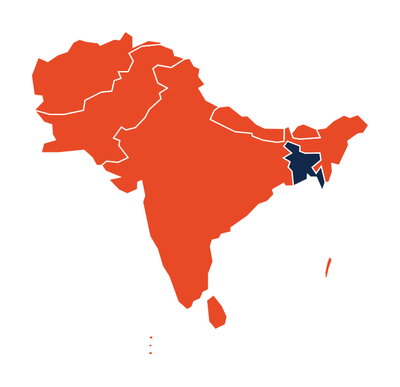
Bangladesh, officially the People's Republic of Bangladesh, is a country in South Asia. It is the eighth-most populous country in the world and among the most densely populated with a population exceeding 170 million within an area of 148,460 square kilometres (57,320 sq mi). Bangladesh shares land borders with India to the north, west, and east, and Myanmar to the southeast. To the south, it has a coastline along the Bay of Bengal. To the north, it is separated from Bhutan and Nepal by the Siliguri Corridor, and from China by the mountainous Indian state of Sikkim. Dhaka, the capital and largest city, is the nation's political, financial, and cultural centre. Chittagong is the second-largest city and the busiest port of the country. The official language is Bengali. Islam is the official and largest religion and Bengali Muslims form the largest ethnoreligious group in the country.
Bangladesh is part of the historic and ethnolinguistic region of Bengal, which was divided during the Partition of British India in 1947 as the eastern exclave of the Dominion of Pakistan. Ancient Bengal was known as Gangaridai and was a stronghold of pre-Islamic kingdoms. The Muslim conquest after 1204 led to the sultanate and Mughal periods, during which an independent Bengal Sultanate and wealthy Mughal Bengal transformed the region into an important centre of regional affairs, trade, and diplomacy. The Battle of Plassey in 1757 marked the beginning of British rule for next 200 years. The creation of Eastern Bengal and Assam in 1905 set a precedent for the emergence of Bangladesh. The All-India Muslim League, which was founded in Dhaka in 1906, fought for a separate Bengali Muslim homeland in the Eastern Bengal, which was proposed in the Lahore Resolution in 1940 by A. K. Fazlul Huq, the first Prime Minister of Bengal. The present-day territorial boundary was established with the announcement of the Radcliffe Line.
In 1947, East Bengal became the most populous province in the Dominion of Pakistan and was renamed East Pakistan, with Dhaka as the legislative capital. The Bengali Language Movement in 1952, the 1958 Pakistani coup d'état, and the 1970 Pakistani general election spurred Bengali nationalism and pro-democracy movements. The refusal of the Pakistani military junta to transfer power to the Awami League, led by Sheikh Mujibur Rahman, triggered the Bangladesh Liberation War in 1971. The Mukti Bahini waged a successful armed revolution; the conflict saw the Bangladeshi genocide. The country came into existence on 16 December 1971 after the surrender of Pakistan, ending the 9-month long Liberation War.
After the war, Sheikh Mujib became the leader of the country. Mujib's assassination in 1975 led to the rise of Ziaur Rahman, who himself was assassinated in 1981. The 1980s was dominated by the presidency of Hussain Muhammad Ershad, who was overthrown in a mass uprising in 1990. After 1990, the "Battle of the Begums" between Khaleda Zia and Sheikh Hasina defined Bangladesh's politics and history for next three decades. Following the overthrow of Hasina in a student–led mass uprising in August 2024, an interim government led by Nobel Peace laureate Muhammad Yunus took power.
Bangladesh is a unitary parliamentary republic based on the Westminster system. It is a middle power with the second-largest economy in South Asia. Bangladesh is home to the third-largest Muslim-majority population and the fifth-most spoken native language. It maintains the third-largest military in South Asia and is the largest contributor to UN peacekeeping operations. It consists of eight divisions, 64 districts, and 495 sub districts, and includes the largest mangrove forest in the world. However, Bangladesh has one of the largest refugee populations in the world and continues to face challenges such as corruption, political instability, overpopulation, and the effects of climate change. It has twice chaired the Climate Vulnerable Forum and hosts the headquarters of the BIMSTEC. Bangladesh is also a founding member of SAARC and a member of the OIC and the Commonwealth of Nations.
[Wikipedia Summary, March 2025]
Bhutan, officially the Kingdom of Bhutan, is a landlocked country in South Asia, situated in the Eastern Himalayas between China in the north and India in the south, with the Indian state of Sikkim separating it from neighbouring Nepal. With a population of over 727,145[15] and a territory of 38,394 square kilometres (14,824 sq mi), Bhutan ranks 133rd in land area and 160th in population. Bhutan is a democratic constitutional monarchy with a King as the head of state and a prime minister as the head of government. The Je Khenpo is the head of the state religion, Vajrayana Buddhism.
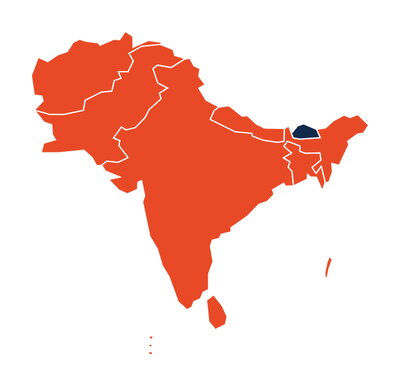
The Himalayan mountains in the north rise from the country's lush subtropical plains in the south. In the Bhutanese Himalayas, there are peaks higher than 7,000 metres (23,000 ft) above sea level. Gangkhar Puensum is Bhutan's highest peak and is the highest unclimbed mountain in the world. The wildlife of Bhutan is notable for its diversity, including the Himalayan takin and golden langur. The capital and largest city is Thimphu, with close to 15% of the population.
Bhutan and neighbouring Tibet experienced the spread of Buddhism, which originated in the Indian subcontinent during the lifetime of the Buddha. In the first millennium, the Vajrayana school of Buddhism spread to Bhutan from the southern Pala Empire of Bengal. During the 16th century, Ngawang Namgyal unified the valleys of Bhutan into a single state. Namgyal defeated three Tibetan invasions, subjugated rival religious schools, codified the Tsa Yig legal system, and established a government of theocratic and civil administrators. Namgyal became the first Zhabdrung Rinpoche and his successors acted as the spiritual leaders of Bhutan, like the Dalai Lama in Tibet. During the 17th century, Bhutan controlled large parts of northeast India, Sikkim and Nepal; it also wielded significant influence in Cooch Behar State.
Although having pursued closer ties with the Britain in the past, Bhutan has never been colonised.[19] Bhutan ceded the Bengal Duars to British India during the Duar War in the 19th century. The Wangchuck dynasty emerged as the monarchy and pursued closer ties with Britain in the subcontinent. In 1910, the Treaty of Punakha guaranteed British advice in foreign policy in exchange for internal autonomy in Bhutan. The arrangement continued under a new treaty with India in 1949 (signed at Darjeeling) in which both countries recognised each other's sovereignty.
Bhutan joined the United Nations in 1971. It has since expanded relations with 55 countries. While dependent on the Indian military, Bhutan maintains its own military units.
The 2008 Constitution established a parliamentary government with an elected National Assembly and a National Council. Bhutan is a founding member of the South Asian Association for Regional Cooperation (SAARC). In 2020, Bhutan ranked third in South Asia after Sri Lanka and the Maldives in the Human Development Index, and 21st on the Global Peace Index as the most peaceful country in South Asia as of 2024, as well as the only South Asian country in the list's first quartile.[20][21] Bhutan is also a member of the Climate Vulnerable Forum, the Non-Aligned Movement, BIMSTEC, the IMF, the World Bank, UNESCO and the World Health Organization (WHO). Bhutan ranked first in SAARC in economic freedom, ease of doing business, peace and lack of corruption in 2016. Bhutan has one of the largest water reserves for hydropower in the world. Melting glaciers caused by climate change are a growing concern in Bhutan.
[Wikipedia summary, March 2025]
India, officially the Republic of India, is a country in South Asia. It is the seventh-largest country by area; the most populous country from June 2023 onwards; and since its independence in 1947, the world's most populous democracy. Bounded by the Indian Ocean on the south, the Arabian Sea on the southwest, and the Bay of Bengal on the southeast, it shares land borders with Pakistan to the west; China, Nepal, and Bhutan to the north; and Bangladesh and Myanmar to the east. In the Indian Ocean, India is near Sri Lanka and the Maldives; its Andaman and Nicobar Islands share a maritime border with Thailand, Myanmar, and Indonesia.
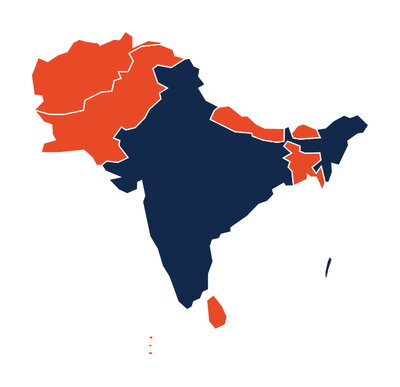
Modern humans arrived on the Indian subcontinent from Africa no later than 55,000 years ago. Their long occupation, predominantly in isolation as hunter-gatherers, has made the region highly diverse, second only to Africa in human genetic diversity. Settled life emerged on the subcontinent in the western margins of the Indus river basin 9,000 years ago, evolving gradually into the Indus Valley Civilisation of the third millennium BCE. By 1200 BCE, an archaic form of Sanskrit, an Indo-European language, had diffused into India from the northwest. Its hymns recorded the dawning of Hinduism in India. India's pre-existing Dravidian languages were supplanted in the northern regions. By 400 BCE, caste had emerged within Hinduism, and Buddhism and Jainism had arisen, proclaiming social orders unlinked to heredity. Early political consolidations gave rise to the loose-knit Maurya and Gupta Empires. Widespread creativity suffused this era, but the status of women declined, and untouchability became an organized belief. In South India, the Middle kingdoms exported Dravidian language scripts and religious cultures to the kingdoms of Southeast Asia.
In the early medieval era, Christianity, Islam, Judaism, and Zoroastrianism became established on India's southern and western coasts. Muslim armies from Central Asia intermittently overran India's northern plains. The resulting Delhi Sultanate drew northern India into the cosmopolitan networks of medieval Islam. In south India, the Vijayanagara Empire created a long-lasting composite Hindu culture. In the Punjab, Sikhism emerged, rejecting institutionalised religion. The Mughal Empire, in 1526, ushered in two centuries of relative peace, leaving a legacy of luminous architecture. Gradually expanding rule of the British East India Company followed. It turned India into a colonial economy but consolidated its sovereignty. British Crown rule began in 1858. The rights promised to Indians were granted slowly, but technological changes were introduced, and modern ideas of education and public life took root. A pioneering and influential nationalist movement emerged. Noted for nonviolent resistance it became the major factor in ending British rule. In 1947, the British Indian Empire was partitioned into two independent dominions, a Hindu-majority dominion of India and a Muslim-majority dominion of Pakistan. A large-scale loss of life and an unprecedented migration accompanied the partition.
India has been a federal republic since 1950, governed through a democratic parliamentary system. It is a pluralistic, multilingual and multi-ethnic society. India's population grew from 361 million in 1951 to almost 1.4 billion in 2022. During this time, its nominal per capita income increased from US$64 annually to US$2,601, and its literacy rate from 16.6% to 74%. A comparatively destitute country in 1951, India has become a fast-growing major economy and a hub for information technology services; it has an expanding middle class.[64] Indian movies and music increasingly influence global culture. India has reduced its poverty rate, though at the cost of increasing economic inequality. It is a nuclear-weapon state that ranks high in military expenditure. It has disputes over Kashmir with its neighbours, Pakistan and China, unresolved since the mid-20th century. Among the socio-economic challenges India faces are gender inequality, child malnutrition, and rising levels of air pollution. India's land is megadiverse with four biodiversity hotspots. India's wildlife, which has traditionally been viewed with tolerance in its culture, is supported among these forests and elsewhere in protected habitats.
[Wikipedia Summary, March 2025]
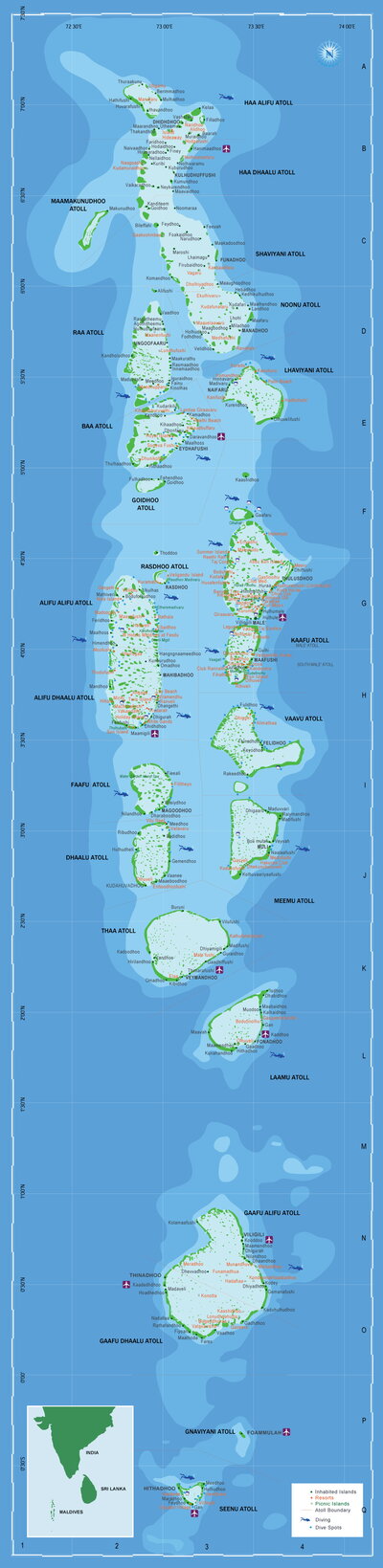
The Maldives, officially the Republic of Maldives, and historically known as the Maldive Islands, is a country and archipelagic state in South Asia in the Indian Ocean. The Maldives is southwest of Sri Lanka and India, about 750 kilometres (470 miles; 400 nautical miles) from the Asian continent's mainland. The Maldives' chain of 26 atolls stretches across the equator from Ihavandhippolhu Atoll in the north to Addu Atoll in the south.
The Maldives is the smallest country in Asia. Its land area is only 298 square kilometres (115 sq mi), but this is spread over roughly 90,000 square kilometres (35,000 sq mi) of the sea, making it one of the world's most spatially dispersed sovereign states. With a population of 515,132 in the 2022 census, it is the second least populous country in Asia and the ninth-smallest country by area, but also one of the most densely populated countries. The Maldives has an average ground-level elevation of 1.5 metres (4 ft 11 in) above sea level, and a highest natural point of only 2.4 metres (7 ft 10 in), making it the world's lowest-lying country. Some sources state the highest point, Mount Villingili, as 5.1 metres or 17 feet.
Malé is the capital and the most populated city, traditionally called the "King's Island", where the ancient royal dynasties ruled from its central location.[11] The Maldives has been inhabited for over 2,500 years. Documented contact with the outside world began around 947 AD when Arab travelers began visiting the islands. In the 12th century, partly due to the importance of the Arabs and Persians as traders in the Indian Ocean, Islam reached the Maldivian Archipelago. The Maldives was soon consolidated as a sultanate, developing strong commercial and cultural ties with Asia and Africa. From the mid-16th century, the region came under the increasing influence of European colonial powers, with the Maldives becoming a British protectorate in 1887. Independence from the United Kingdom came in 1965, and a presidential republic was established in 1968 with an elected People's Majlis. The ensuing decades have seen political instability, efforts at democratic reform, and environmental challenges posed by climate change and rising sea levels. The Maldives became a founding member of the South Asian Association for Regional Cooperation (SAARC).
The Maldives is a member of the United Nations, the Commonwealth of Nations, the Organisation of Islamic Cooperation, and the Non-Aligned Movement. The World Bank classifies the Maldives as having an upper-middle income economy. The Maldives is a Dialogue Partner of the Shanghai Cooperation Organisation. Fishing has historically been the dominant economic activity, and remains the largest sector by far, followed by the rapidly growing tourism industry. The Maldives rates "high" on the Human Development Index, with per capita income significantly higher than other SAARC nations. The Maldives was a member of the Commonwealth of Nations from July 1982 until withdrawing from the organisation in October 2016 in protest of allegations of its human rights abuses and failing democracy. The Maldives rejoined the Commonwealth on 1 February 2020 after showing evidence of functioning democratic processes and popular support.
[Wikipedia Summary, March 2025]
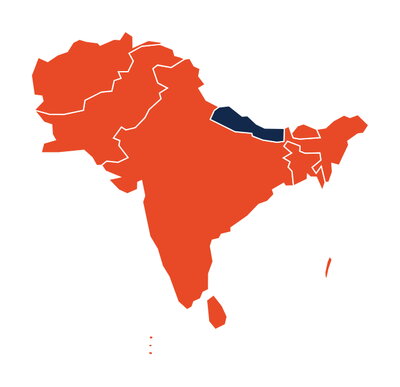
Nepal,[a] officially the Federal Democratic Republic of Nepal,[b] is a landlocked country in South Asia. It is mainly situated in the Himalayas, but also includes parts of the Indo-Gangetic Plain. It borders the Tibet Autonomous Region of China to the north, and India to the south, east, and west, while it is narrowly separated from Bangladesh by the Siliguri Corridor, and from Bhutan by the Indian state of Sikkim. Nepal has a diverse geography, including fertile plains, subalpine forested hills, and eight of the world's ten tallest mountains, including Mount Everest, the highest point on Earth. Kathmandu is the nation's capital and the largest city. Nepal is a multi-ethnic, multi-lingual, multi-religious, and multi-cultural state, with Nepali as the official language.
The name "Nepal" is first recorded in texts from the Vedic period of the Indian subcontinent, the era in ancient Nepal when Hinduism was founded, the predominant religion of the country. In the middle of the first millennium BC, Gautama Buddha, the founder of Buddhism, was born in Lumbini in southern Nepal. Parts of northern Nepal were intertwined with the culture of Tibet. The centrally located Kathmandu Valley is intertwined with the culture of Indo-Aryans, and was the seat of the prosperous Newar confederacy known as Nepal Mandala. The Himalayan branch of the ancient Silk Road was dominated by the valley's traders. The cosmopolitan region developed distinct traditional art and architecture. By the 18th century, the Gorkha Kingdom achieved the unification of Nepal. The Shah dynasty established the Kingdom of Nepal and later formed an alliance with the British Empire, under its Rana dynasty of premiers. The country was never colonised but served as a buffer state between Imperial China and British India. Parliamentary democracy was introduced in 1951 but was twice suspended by Nepalese monarchs, in 1960 and 2005. The Nepalese Civil War in the 1990s and early 2000s resulted in the establishment of a secular republic in 2008, ending the world's last Hindu monarchy.
The Constitution of Nepal, adopted in 2015, affirms the country as a federal parliamentary republic divided into seven provinces. Nepal was admitted to the United Nations in 1955, and friendship treaties were signed with India in 1950 and China in 1960. Nepal hosts the permanent secretariat of the South Asian Association for Regional Cooperation (SAARC), of which it is a founding member. Nepal is also a member of the Non-Aligned Movement and the Bay of Bengal Initiative.
[Wikipedia summary, March 2025]
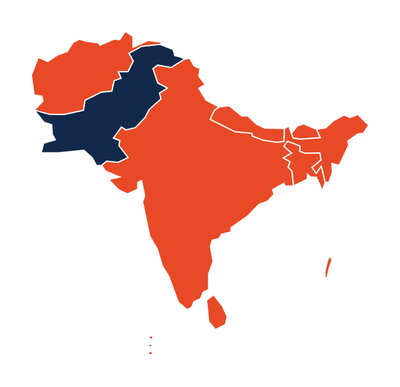
Pakistan, officially the Islamic Republic of Pakistan, is a country in South Asia. It is the fifth-most populous country, with a population of over 241.5 million, having the second-largest Muslim population as of 2023. Islamabad is the nation's capital, while Karachi is its largest city and financial centre. Pakistan is the 33rd-largest country by area. Bounded by the Arabian Sea on the south, the Gulf of Oman on the southwest, and the Sir Creek on the southeast, it shares land borders with India to the east; Afghanistan to the west; Iran to the southwest; and China to the northeast. It shares a maritime border with Oman in the Gulf of Oman, and is separated from Tajikistan in the northwest by Afghanistan's narrow Wakhan Corridor.
Pakistan is the site of several ancient cultures, including the 8,500-year-old Neolithic site of Mehrgarh in Balochistan, the Indus Valley Civilisation of the Bronze Age, and the ancient Gandhara civilisation. The regions that compose the modern state of Pakistan were the realm of multiple empires and dynasties, including the Achaemenid, the Maurya, the Kushan, the Gupta; the Umayyad Caliphate in its southern regions, the Hindu Shahis, the Ghaznavids, the Delhi Sultanate, the Samma, the Shah Miris, the Mughals, and most recently, the British Raj from 1858 to 1947.
Spurred by the Pakistan Movement, which sought a homeland for the Muslims of British India, and election victories in 1946 by the All-India Muslim League, Pakistan gained independence in 1947 after the Partition of the British Indian Empire, which awarded separate statehood to its Muslim-majority regions and was accompanied by an unparalleled mass migration and loss of life. Initially a Dominion of the British Commonwealth, Pakistan officially drafted its constitution in 1956, and emerged as a declared Islamic republic. In 1971, the exclave of East Pakistan seceded as the new country of Bangladesh after a nine-month-long civil war. In the following four decades, Pakistan has been ruled by governments that alternated between civilian and military, democratic and authoritarian, relatively secular and Islamist.
Pakistan is considered a middle power nation, with the world's sixth-largest standing armed forces. It is a declared nuclear-weapons state, and is ranked amongst the emerging and growth-leading economies, with a large and rapidly growing middle class. Pakistan's political history since independence has been characterized by periods of significant economic and military growth as well as those of political and economic instability. It is an ethnically and linguistically diverse country, with similarly diverse geography and wildlife. The country continues to face challenges, including poverty, illiteracy, corruption, and terrorism. Pakistan is a member of the United Nations, the Shanghai Cooperation Organisation, the Organisation of Islamic Cooperation, the Commonwealth of Nations, the South Asian Association for Regional Cooperation, and the Islamic Military Counter-Terrorism Coalition, and is designated as a major non-NATO ally by the United States.
[Wikipedia Summary, March 2025]
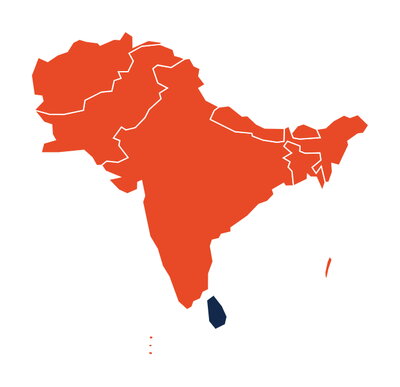
Sri Lanka, historically known as Ceylon, and officially the Democratic Socialist Republic of Sri Lanka, is an island country in South Asia. It lies in the Indian Ocean, southwest of the Bay of Bengal, separated from the Indian peninsula by the Gulf of Mannar and the Palk Strait. It shares a maritime border with the Maldives in the southwest and India in the northwest. Sri Jayawardenepura Kotte is the legislative capital of Sri Lanka and the largest city, Colombo is the administrative and judicial capital which is the nation's political, financial and cultural centre. Kandy is the second-largest urban area and also the capital of the last native kingdom of Sri Lanka. The most spoken language Sinhala, is spoken by the majority of the population (approximately 17 million). Tamil is also spoken by approximately five million people, making it the second most-spoken language in Sri Lanka.
Sri Lanka has a population of approximately 22 million and is home to several cultures, languages and ethnicities. The Sinhalese people form the majority of the population, followed by the Sri Lankan Tamils, who are the largest minority group and are concentrated in northern Sri Lanka; both groups have played an influential role in the island's history. Other long-established groups include the Moors, Indian Tamils, Burghers, Malays, Chinese, and Vedda.
Sri Lanka's documented history goes back 3,000 years, with evidence of prehistoric human settlements dating back 125,000 years. The earliest known Buddhist writings of Sri Lanka, known collectively as the Pali Canon, date to the fourth Buddhist council, which took place in 29 BCE. Also called the Pearl of the Indian Ocean, or the Granary of the East, Sri Lanka's geographic location and deep harbours have made it of great strategic importance, from the earliest days of the ancient Silk Road trade route to today's so-called maritime Silk Road. Because its location made it a major trading hub, it was already known to both East Asians and Europeans as long ago as the Anuradhapura period. During a period of great political crisis in the Kingdom of Kotte, the Portuguese arrived in Sri Lanka and sought to control its maritime trade, with a part of Sri Lanka subsequently becoming a Portuguese possession. After the Sinhalese–Portuguese War, the Dutch colonial empire and the Kingdom of Kandy took control of those areas. Dutch Ceylon was taken by the British Empire, which extended control over the whole island, colonising it as British Ceylon from 1815 to 1948. A national movement for political independence arose in the early 20th century, and in 1948, Ceylon became a dominion. It was succeeded by the republic of Sri Lanka in 1972. Sri Lanka's more recent history was marred by the 26-year Sri Lankan Civil War, which began in 1983 and ended in 2009, when the Sri Lanka Armed Forces defeated the Liberation Tigers of Tamil Eelam.
Sri Lanka is a developing country, ranking 78th on the Human Development Index. It is the highest-ranked South Asian nation in terms of development and has the second-highest per capita income in South Asia. The country has had a long history of engagement with modern international groups; it is a founding member of the SAARC, the G77 and the Non-Aligned Movement, as well as a member of the United Nations and the Commonwealth of Nations.
125 Coble Hall
801 South Wright Street
Champaign, IL 61801
Email: csames@illinois.edu