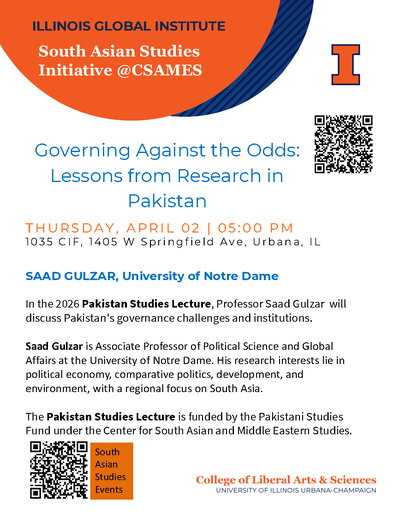
Professor Saad Gulzar, University of Notre Dame
THURSDAY, APRIL 2, 5 PM, 1035 CIF
Governing Against the Odds: Lessons from Research in Pakistan
Pakistan is typically viewed as a site of intractable governance challenges. In this lecture, I draw on over a decade of field experiments, satellite data, and administrative records to argue that the evidence base for reform in Pakistan is stronger than the prevailing pessimism suggests, and that the appetite for improvement among citizens, politicians, and bureaucrats is widespread. Across studies of politics, health and education delivery, crop burning, and policing, I show that many governance failures reflect how institutions structure incentives: framing political office as public service dramatically increases candidacy and improves budgets; bureaucrats curb deadly pollution when properly incentivized; digital access to justice reveals hidden demand from women facing violence. Where interventions fall short, the failures prove diagnostic, pointing to specific design problems with identifiable solutions. The lecture synthesizes these findings to argue that Pakistan's governance challenges are best understood as products of institutional design, and therefore as problems within reach of reform.
Saad Gulzar is an Associate Professor of Political Science and Global Affairs at the University of Notre Dame. His research interests lie in political economy, comparative politics, development, and environment, with a regional focus on South Asia. Previously, he was an Assistant Professor at Stanford University and Princeton University. He received his Ph.D. at New York University in 2017.
Title
Saad Gulzar Poster